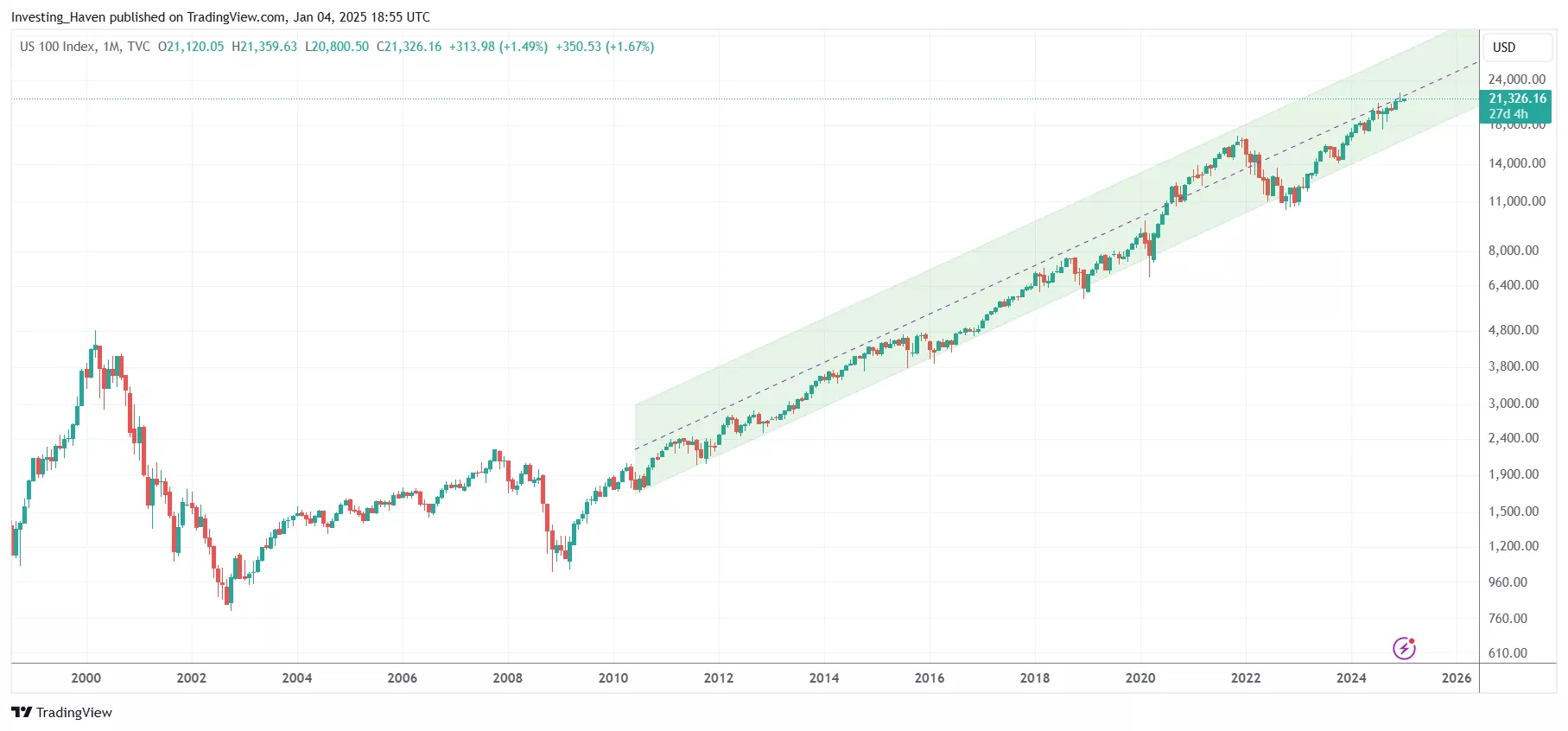

summary:
U.S. stocks are not automatically too expensive because Treasury yields are approaching 5%, but the hurdle rate for equities is clearly higher. With the 10-year Treasury near 4.8%, elevated stock-market valuations, strong corporate earnings, and persistent inflation and fiscal concerns, investors should focus less on predicting a crash and more on earnings growth, valuation, diversification, and time horizon.
Why Near-5% Treasury Yields Matter So Much
For much of the post-2008 era, investors became accustomed to unusually low interest rates. That environment helped make stocks—particularly growth stocks—more attractive because the alternatives offered by high-quality bonds were relatively limited.
That calculation is changing.
The U.S. 10-year Treasury yield recently climbed to roughly 4.8%, with the benchmark briefly reaching 4.818% on September 2, its highest level since November 2023. The move has attracted attention because a sustained approach toward 5% can affect stock valuations, corporate borrowing costs and the relative attractiveness of bonds.
This does not mean investors should automatically sell stocks.
It does mean the market has less room for valuation mistakes.
A Treasury security backed by the U.S. government offers a comparatively predictable nominal return. Stocks, by contrast, represent ownership in businesses whose future profits are uncertain. When the risk-free rate rises, investors generally demand a more compelling expected return from equities.
That is the central issue behind today’s question:
If you can earn close to 5% from a relatively low-risk government bond, how much should you pay for a dollar of corporate earnings?
The answer depends on earnings growth, inflation, economic conditions, valuation and your investment horizon.
Are U.S. Stocks Actually Overvalued Right Now?
There is evidence supporting both sides of the argument.
On one hand, broad-market valuations remain elevated compared with historical norms. FactSet’s July 2026 analysis put the S&P 500’s forward 12-month price-to-earnings ratio at approximately 20.1, above its five-year average of 19.9 and 10-year average of 19.0.
The cyclically adjusted P/E ratio, commonly known as the Shiller CAPE, was around 41.9 in early September 2026. That is substantially above its long-run historical levels, although valuation metrics can remain elevated for long periods and should not be treated as precise market-timing tools.
On the other hand, today’s market is not simply trading at a high multiple with no earnings behind it.
Corporate profits have been strong. FactSet’s August earnings update projected S&P 500 earnings growth of approximately 30% for calendar-year 2026, while its Q3 and Q4 estimates were also pointing to substantial year-over-year growth.
That distinction matters.
A market can look expensive using historical valuation measures while still being supported by unusually strong earnings growth. Conversely, even excellent companies can become poor investments if investors pay too high a price for those earnings.
The question therefore isn’t simply “Are stocks expensive?”
It is:
“Are expected future earnings strong enough to justify today’s prices when Treasury yields are materially higher?”
The Stock Market’s Real Competition Is No Longer Just Cash
Investors often compare stocks with savings accounts or money-market funds. But the more important comparison for valuation is often longer-term government bonds.
Imagine two hypothetical investments.
Investment A is a high-quality Treasury yielding approximately 4.8% annually.
Investment B is a stock index that might deliver substantially more over a long period, but whose returns can be negative for months or even years.
The stock investor needs compensation for accepting that uncertainty.
This is sometimes described through the equity risk premium—the additional expected return investors demand for owning equities instead of relatively safer assets.
As Treasury yields rise, the required compensation for owning stocks can become more demanding.
This doesn’t create a simple mathematical rule saying that stocks must fall whenever the 10-year yield reaches a certain level. Markets don’t operate on a single threshold.
Instead, higher yields can gradually change investor behavior.
A retiree who previously kept a smaller bond allocation may now find high-quality Treasuries more appealing. A pension fund may reconsider its allocation. An institutional investor comparing expected equity returns with bond yields may become less willing to pay extremely high multiples for stocks.
That incremental change in demand can matter enormously when valuations are already elevated.

Why Strong Earnings Could Keep Stocks Supported
There is another side to the story that investors should not overlook.
Higher interest rates are painful for businesses, but they do not affect every company equally.
A company generating billions of dollars in free cash flow, carrying relatively modest debt and growing earnings quickly is in a different position from a highly leveraged company whose profits are years away.
This is particularly important in the current AI-driven market.
Technology and communications companies have benefited from enormous investment in computing infrastructure, cloud services, semiconductors and data centers. The sustainability of that spending is now one of the market’s major questions.
If AI-related investment produces durable revenue and earnings growth, elevated valuations may be easier to justify.
If expectations become disconnected from actual profits, however, higher Treasury yields could amplify the adjustment.
Reuters recently noted that rising yields are particularly challenging for sectors whose valuations depend heavily on future cash flows, including parts of the AI investment complex.
That is why investors should watch earnings revisions, not just stock prices.
If analysts repeatedly raise earnings forecasts while share prices remain stable, valuations can become more reasonable without a major market decline.
If earnings forecasts fall while stock prices continue rising, the opposite happens.
What Happens If the 10-Year Treasury Yield Reaches 5%?
A move from roughly 4.8% to 5% may look small.
It is only 20 basis points.
But the psychological significance of the 5% level can be larger than the numerical difference suggests.
A sustained 5% yield would reinforce the idea that investors can obtain a meaningful nominal return from U.S. government debt. It could also signal that the market is demanding higher compensation because of inflation, fiscal deficits, Treasury supply or economic uncertainty.
Recent commentary from Federal Reserve Governor Christopher Waller highlighted another structural issue: he argued that the historical safety premium associated with Treasuries has diminished and that fiscal conditions could contribute to a higher neutral interest rate.
For stock investors, the important question is not whether 5% is a magic number.
It is why yields are rising.
That distinction is crucial.
If yields rise because economic growth is strong
That could be relatively manageable for stocks. Strong growth can produce stronger corporate revenue and earnings, partially offsetting the valuation pressure caused by higher discount rates.
If yields rise because inflation is returning
That is more complicated.
Higher inflation can pressure margins, increase wages and input costs, and make it harder for the Federal Reserve to reduce rates.
If yields rise because investors are increasingly concerned about fiscal sustainability
That could create a different challenge. Higher government borrowing costs can influence the broader cost of capital throughout the economy.
If yields rise because markets expect tighter monetary policy
Interest-sensitive sectors may face immediate pressure as investors adjust their expectations.
In other words, the cause of the yield increase may matter more than the number itself.
What About the Federal Reserve?
The Federal Reserve remains one of the most important variables for investors.
But investors should avoid reducing every market movement to a single question: “Will the Fed cut or hike?”
The longer-term 10-year Treasury yield is influenced by much more than the federal funds rate.
Inflation expectations, economic growth, Treasury issuance, global demand for U.S. debt and expectations for future monetary policy all matter.
Recent market moves demonstrate the complexity. Treasury yields rose sharply even as investors evaluated incoming economic data and changing expectations for Federal Reserve policy. Reuters reported that Waller’s September 3 comments helped cool expectations of an imminent rate increase, while the 10-year yield subsequently eased from its recent peak.
For investors, this means reacting to every Fed headline can become counterproductive.
Instead, watch the broader combination of:
- Inflation trends
- Labor-market conditions
- Treasury yields
- Corporate earnings
- Credit conditions
- Consumer spending
- Long-term earnings expectations
The market’s direction will ultimately depend on how those pieces interact.
What Should Investors Watch in the Stock Market Now?
The most useful approach is to establish a short list of indicators rather than trying to predict the next S&P 500 move.
1. Watch earnings growth
Valuation matters, but earnings ultimately provide the foundation for long-term stock returns.
If companies continue delivering strong earnings growth, today’s valuation may become easier to defend.
If earnings expectations begin falling broadly, elevated valuations become more concerning.
2. Watch the 10-year Treasury yield
Don’t obsess over whether the yield is 4.79% or 4.91%.
Look instead for direction and persistence.
A temporary spike can be absorbed. A sustained move higher can change valuation assumptions throughout the market.
3. Watch the earnings yield versus Treasury yields
The inverse of the P/E ratio provides a rough earnings yield.
For example, a 20x P/E corresponds to an earnings yield of approximately 5%.
That doesn’t mean a stock-market index literally pays investors a 5% cash yield—earnings are not the same as dividends—but it provides a useful valuation comparison.
With Treasury yields approaching 5%, that comparison becomes increasingly important.
4. Watch market concentration
A major risk is assuming that “the stock market” is one uniform asset.
The S&P 500 contains companies with very different valuations, balance sheets and growth prospects.
A handful of mega-cap companies can significantly influence index-level valuation and performance.
Investors should therefore examine whether their portfolio is unintentionally concentrated in the same technology and AI themes.
5. Watch credit markets
Credit spreads can provide useful information about financial stress.
If investors suddenly demand substantially higher compensation for lending to corporations, that can indicate deteriorating economic or financial conditions.
6. Watch inflation
Inflation is particularly important because it affects both sides of the equation.
Persistent inflation can keep Treasury yields elevated while also increasing business costs.
That combination can be particularly uncomfortable for richly valued stocks.

Should You Sell Stocks and Buy Treasuries?
For most long-term investors, that is the wrong way to frame the decision.
A better question is:
“Is my current mix of stocks, bonds and cash appropriate for my goals and risk tolerance?”
Consider a 45-year-old investor with a 20-year retirement horizon.
A market decline may be uncomfortable, but there is considerable time to recover.
Now consider a 72-year-old investor who expects to withdraw $60,000 from a portfolio over the next year.
The second investor has a much stronger reason to care about short-term volatility and liquidity.
The same Treasury yield can therefore mean very different things to two households.
For someone approaching retirement, higher Treasury yields may make it easier to build a short- or intermediate-term income allocation without taking excessive equity risk.
For a younger investor making regular 401(k) contributions, a higher yield environment does not necessarily justify abandoning stocks.
The key is matching the portfolio to the job the money needs to perform.
Is This a Good Time to Buy Stocks?
There is no reliable answer that applies to every investor.
But there is a useful distinction between market timing and valuation discipline.
Suppose an investor has $100,000 to invest and believes the market is expensive.
One option is to put the entire amount into stocks immediately.
Another is to keep the entire $100,000 in cash while waiting for a correction.
Both approaches introduce timing risk.
A third approach could be to invest according to a predetermined allocation, potentially spreading new investments over several months while maintaining appropriate exposure to stocks and high-quality fixed income.
The best approach depends on the investor’s circumstances, but the important principle is avoiding an all-or-nothing decision based on a single market indicator.
Historically, markets can remain expensive longer than investors expect. They can also fall sharply without providing an obvious warning.
What Could Make Today’s Valuations More Reasonable?
There are several ways this can happen.
The most obvious is a market decline. If stock prices fall while earnings remain relatively stable, P/E ratios decline.
But that isn’t the only mechanism.
Earnings can grow into the valuation.
Suppose a hypothetical company trades at 30 times earnings. If its earnings increase dramatically over the next several years while its share price rises much more slowly, the valuation multiple can fall substantially without the stock experiencing a major crash.
That is one reason earnings growth deserves as much attention as the headline market multiple.
The opposite is also possible.
If earnings disappoint while stock prices remain elevated, valuation becomes more stretched.
Investors should therefore resist the temptation to treat a single P/E number as a prediction of what happens next.
The Biggest Risk May Be Paying Too Much for Certainty
One of the less obvious risks in today’s market is not simply that stocks could decline.
It is that investors may assume they know which scenario will happen.
The bullish case is straightforward: strong corporate earnings, continued productivity gains from AI, resilient consumer spending and eventually lower interest rates could support equities.
The bearish case is equally recognizable: persistent inflation, higher Treasury yields, fiscal concerns and disappointing AI returns could compress valuations.
Neither outcome is guaranteed.
The practical response is not necessarily to choose one forecast and build an entire portfolio around it.
It is to construct a portfolio capable of surviving several plausible outcomes.
That could mean maintaining appropriate diversification across equities and fixed income, keeping sufficient liquidity, reviewing concentration risk and avoiding leverage that could force a sale during a downturn.
What This Means for Everyday U.S. Investors
For many Americans, the question isn’t really whether the S&P 500 is 10% overvalued or 15% undervalued.
It is whether today’s market changes what they should do with their retirement contributions.
For someone contributing to a 401(k) every paycheck, a higher Treasury yield does not automatically invalidate a long-term stock allocation.
For someone holding a large cash balance, however, higher yields create a genuine opportunity to reconsider how much cash is necessary and how much could be allocated to intermediate- or long-term investments.
For someone nearing retirement, higher bond yields can improve the income-producing side of a diversified portfolio.
And for someone heavily concentrated in a few technology stocks, today’s environment is a good reason to examine whether portfolio risk has quietly become much higher than it appears.
The answer is therefore less about “stocks versus bonds” and more about price, purpose and time horizon.
Frequently Asked Questions
1. Is the U.S. stock market overvalued in 2026?
Several valuation measures indicate that U.S. stocks are expensive relative to long-term historical averages. FactSet’s forward P/E measure has remained above its 10-year average, while the Shiller CAPE is considerably elevated. However, strong expected earnings growth provides an important counterargument.
2. Why do higher Treasury yields hurt stocks?
Higher yields increase the return available from bonds and can raise the discount rate investors use when valuing future corporate earnings. They can also increase borrowing costs for businesses and households.
3. Is a 5% Treasury yield bad for the stock market?
Not necessarily. The economic reason behind the higher yield matters. Rising yields caused by strong economic growth may be easier for stocks to absorb than rising yields caused by persistent inflation or fiscal concerns.
4. Should I buy Treasuries instead of stocks?
That depends on your goals, time horizon and risk tolerance. Treasuries can provide predictable income and lower volatility than stocks, but they generally offer less long-term growth potential than equities.
5. What happens to growth stocks when interest rates rise?
Growth stocks can be particularly sensitive because a larger portion of their valuation may depend on profits expected far into the future. Higher discount rates can reduce the present value investors assign to those future cash flows.
6. Should I wait for a stock-market crash before investing?
Waiting can backfire if markets continue rising. Rather than trying to identify the exact bottom, many long-term investors use diversified portfolios and systematic contributions to reduce dependence on perfect market timing.
7. What should investors watch if the 10-year Treasury reaches 5%?
Focus on whether the move is temporary or persistent, and examine its cause. Inflation, Federal Reserve expectations, economic growth, Treasury supply and fiscal concerns can all influence long-term yields.
8. Does strong earnings growth justify high stock valuations?
It can. Rapidly growing earnings can make a high valuation more reasonable over time. But investors still need to compare expected growth with the price being paid.
9. Are Treasury bonds safer than stocks?
U.S. Treasury securities have substantially different risk characteristics from stocks, particularly regarding credit risk. However, Treasury prices can fall when interest rates rise, especially for longer-duration bonds, and inflation can reduce the purchasing power of fixed payments.
10. What is the biggest mistake investors can make in an expensive market?
Making a portfolio decision based entirely on a market forecast. Investors can reduce this risk by diversifying, maintaining an appropriate time horizon, controlling concentration and periodically rebalancing rather than making emotional all-in or all-out decisions.
When the Yield Changes, Recheck the Equation
Near-5% Treasury yields don’t automatically make U.S. stocks uninvestable. They do, however, change the financial equation.
Investors are now asking stocks to compete against a much more meaningful alternative return from government bonds. That raises the standard for valuation, particularly for companies whose share prices depend heavily on aggressive future growth assumptions.
At the same time, strong corporate earnings mean the market cannot be evaluated solely through the lens of interest rates. If profits continue growing rapidly, companies may be able to justify valuations that would have looked harder to defend under weaker earnings conditions.
The most sensible conclusion is therefore neither “sell everything” nor “ignore valuations.”
Instead, investors should monitor the relationship between Treasury yields, inflation, earnings growth and equity valuations while keeping their portfolio aligned with their own time horizon.
A market that looks expensive can continue rising.
A market that looks reasonably valued can fall.
What investors can control is not the next move in the S&P 500, but how much risk they take, what they pay for investments, how diversified they are, and whether they can stay invested when markets inevitably become uncomfortable.
The Numbers Worth Keeping on Your Dashboard
- 10-year Treasury yield: Watch the direction and whether elevated yields persist.
- S&P 500 forward P/E: Compare today’s valuation with both recent and longer-term averages.
- Corporate earnings revisions: Rising estimates can support higher valuations; falling estimates can undermine them.
- Inflation: Persistent inflation can keep long-term yields elevated.
- Federal Reserve policy: Focus on the broader policy path rather than individual headlines.
- Portfolio concentration: Check whether a few mega-cap or AI-related holdings dominate your risk.
- Time horizon: A 20-year investor and a retiree withdrawing money next year should not make the same decision.
- Diversification: Use stocks, high-quality fixed income and cash according to the role each needs to play.
- Rebalancing: Periodic rebalancing can help prevent market winners from quietly becoming an outsized portfolio risk.
- Discipline: Avoid making major allocation changes solely because a market index reaches a round-number yield or valuation level.
This article is for informational and educational purposes only and is not individualized investment, tax, or financial advice. Market conditions and economic data can change quickly.