
60-Word Summary:
The U.S. stock market in 2026 is being shaped by a delicate mix of earnings growth, artificial-intelligence investment, interest-rate expectations, inflation, Treasury yields, consumer spending, and geopolitical risk. With major indexes near record levels, investors should look beyond headline gains and monitor corporate profitability, inflation trends, bond yields, Federal Reserve signals, market breadth, and AI spending for clues about what comes next.
The Market’s 2026 Story Is More Complicated Than the Headlines
The U.S. stock market has delivered a strong performance in 2026, but the forces behind that performance are changing. As of August 24, the S&P 500 was up 11.8% for the year, matching the Nasdaq’s 11.8% gain, while the Dow was up 11.1% and the Russell 2000 had gained 20.7%.
Those numbers can make the market look straightforward: stocks are rising because investors are optimistic. The reality is more nuanced. Investors are constantly reassessing the relationship between corporate earnings, inflation, interest rates, economic growth and valuations.
That distinction matters because a market can continue rising while the reasons supporting it evolve. A rally initially driven by expectations for easier monetary policy, for example, can become increasingly dependent on earnings growth. If earnings remain strong, elevated valuations can be supported. If earnings disappoint while bond yields rise, the same valuations can become much harder to justify.
The key question for the rest of 2026 is therefore not simply whether stocks are going up. It is what is supporting those prices—and whether those supports are becoming stronger or weaker.
Corporate Earnings Remain the Most Important Fundamental Driver
Over long periods, stock prices ultimately have to connect to the ability of companies to generate profits and cash flow. In 2026, that relationship has been especially important because earnings growth has been unusually strong.
According to Reuters, S&P 500 companies reported a 52% year-over-year increase in aggregate second-quarter earnings. Technology-sector profits rose 74%, although some of that growth reflected mark-to-market investment gains at major companies. Even after excluding those gains, aggregate earnings growth remained a substantial 33%.
That helps explain why investors have been willing to tolerate relatively high valuations in parts of the market. Strong earnings can provide the fundamental justification for higher share prices.
But investors should look beyond the headline earnings number. The more useful questions are whether revenue is growing, whether operating margins are sustainable, whether companies are generating free cash flow and whether management teams are maintaining or raising forward guidance.
Consider two hypothetical technology companies. Company A reports a 25% increase in earnings because revenue is expanding, margins are improving and demand is broadening. Company B reports the same 25% increase, but the improvement comes largely from financial gains or temporary cost reductions. The two results look similar on an earnings headline, but the quality of growth is very different.
That distinction will become increasingly important as 2026 progresses.
Artificial Intelligence Is Still a Major Market Engine—but Expectations Are Higher
Artificial intelligence remains one of the defining investment themes of 2026. Semiconductor companies, cloud providers, data-center operators and software businesses have benefited from expectations that AI-related infrastructure spending will remain substantial.
Yet the market is moving into a more demanding phase of the AI cycle.
Investors are no longer asking only whether companies will spend billions on AI infrastructure. They increasingly want evidence that those investments will produce measurable revenue, productivity gains and returns on capital.
That is why Nvidia’s upcoming earnings have become such a major market event this week. Reuters reported that investors are watching the company’s results for evidence that AI-driven demand remains strong, while also questioning valuations and the financing structures supporting the enormous data-center buildout.
The practical signal to watch is AI monetization.
Investors should pay attention to:
- Cloud revenue associated with AI workloads
- Data-center capital expenditures
- Semiconductor demand and supply constraints
- AI-related operating expenses
- Customer adoption beyond a small group of technology giants
- Management commentary about returns on AI investment
If AI spending continues rising but returns fail to appear, investors may eventually demand lower valuations. If companies demonstrate that AI is materially increasing revenue or productivity, the current investment cycle could remain powerful for longer.
Interest Rates and Treasury Yields Could Become the Market’s Biggest Counterweight
The Federal Reserve remains one of the most important variables for U.S. equities.
At its July 28–29 meeting, the Federal Open Market Committee kept the federal funds target range at 3.50% to 3.75%. Three members dissented and preferred a quarter-point increase. The Fed said economic activity was expanding at a solid pace, while inflation remained elevated relative to its 2% goal.
That creates an unusual setup. Economic growth has not collapsed, but inflation is not yet comfortably back at target. The result is a market that must continuously reassess how restrictive monetary policy needs to remain.
Treasury yields matter because they influence the discount rate applied to future corporate cash flows. When long-term yields rise, high-growth stocks can become more difficult to value because more of their expected cash flows sit far in the future.
Recent market action illustrates the relationship. On August 25, the 10-year Treasury yield was around 4.67% in early trading, while lower yields helped support technology shares.
For investors, the important signal is not simply whether the Fed cuts or raises rates. The bigger question is why rates are moving.
A decline in yields caused by falling inflation and stable growth can be supportive for stocks. A decline caused by rapidly deteriorating economic conditions could tell a very different story.
Inflation Is Improving, but the Problem Has Not Disappeared
The latest inflation data provide a useful example of why investors need to look beyond one monthly number.
The Bureau of Labor Statistics reported that CPI increased 0.1% in July and was up 3.4% from a year earlier. Core CPI, excluding food and energy, increased 2.5% over the year. Energy prices were particularly notable, rising 14.7% over the 12-month period.
That is considerably more progress than the inflation extremes of the early 2020s, but it is still above the Federal Reserve’s 2% objective.
For stock investors, inflation matters through several channels. Persistent inflation can keep interest rates higher, pressure consumer purchasing power, raise labor and input costs and make corporate margins more difficult to maintain.
The next stage of the market will therefore depend heavily on whether inflation continues moving gradually lower or becomes stuck above the Fed’s preferred range.
An investor evaluating a consumer company, for example, should consider whether that business can raise prices without losing customers. A company with strong pricing power may cope well with inflation. Another business with thin margins and price-sensitive customers may struggle.

The Economy Is Growing, but the Pace Deserves Attention
The U.S. economy is not currently signaling a classic recessionary environment.
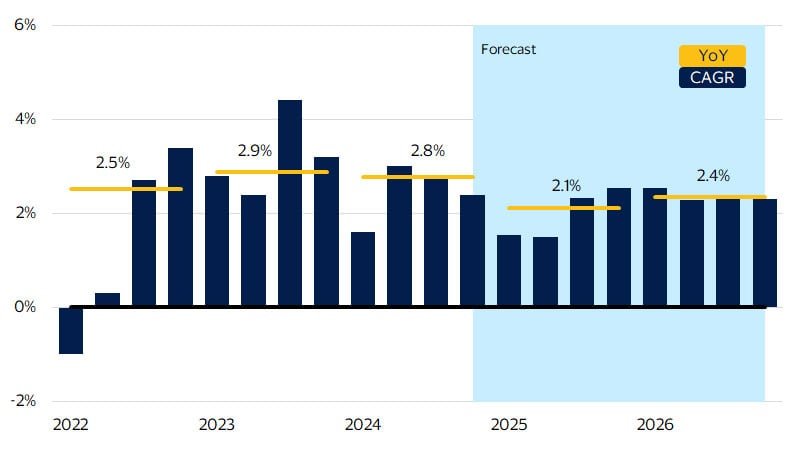
The BEA’s advance estimate showed real GDP growing at a 1.5% annual rate in the second quarter of 2026, following 2.1% growth in the first quarter. Consumer spending and investment contributed to Q2 growth, while government spending declined.
That is slower than the first quarter, but still positive.
The next GDP estimate, scheduled for August 26, will therefore be important because revisions can change how investors interpret the economy.
For equities, a “soft landing” remains a favorable scenario: economic activity continues expanding, inflation gradually cools and monetary policy becomes less restrictive without a major deterioration in employment.
The risk is that growth slows faster than expected while inflation remains elevated. That combination would give policymakers less room to stimulate the economy and could create a more difficult environment for stocks.
Consumer Spending Is Another Signal Worth Watching
The U.S. consumer remains central to the market because consumer spending accounts for a large share of economic activity.
The important issue in 2026 is not merely whether Americans are still spending. It is how they are spending and whether that spending is sustainable.
Higher-income consumers may continue spending on travel, technology and services even when lower-income households become more cautious. That creates a more uneven consumer environment than a simple retail-sales headline might suggest.
Investors should therefore examine company earnings reports for signs of changing consumer behavior: lower transaction volumes, increased promotional activity, smaller basket sizes, rising credit delinquencies or stronger demand for value-oriented products.
A retailer that maintains revenue only by discounting heavily may be in a weaker position than one that maintains both sales and margins.
Government Debt and the Bond Market Are Moving Closer to Center Stage
Another issue receiving increasing attention is the U.S. government’s borrowing needs and their effect on Treasury markets.
Recent market volatility has shown how concerns about government debt and elevated long-term yields can spill over into equities. AP reported that Treasury actions to increase planned purchases of longer-term securities temporarily eased pressure on the bond market, while investors continued to question whether inflation, debt levels and policy credibility could keep yields elevated.
This creates an important signal for stock investors: watch the bond market even if you primarily own stocks.
If long-term Treasury yields rise sharply, equity valuations may come under pressure even when corporate earnings remain healthy. Conversely, a stable bond market can give investors more confidence in high-growth equity valuations.
Market Breadth Could Tell Investors Whether the Rally Is Broadening
Indexes can sometimes hide what is happening underneath the surface.
A market driven by a small number of mega-cap technology companies is different from one in which financials, industrials, consumer companies, small caps and other sectors are participating broadly.
The Russell 2000’s strong 2026 performance is therefore worth monitoring alongside the S&P 500. As of August 24, small-cap stocks represented by the Russell 2000 were up 20.7% for the year, well ahead of the major large-cap indexes.
Broad participation can suggest that investors are becoming more comfortable with the economic outlook. Narrow participation can indicate that investors remain concentrated in companies perceived to have the strongest earnings or structural growth prospects.
Neither condition automatically predicts the next market move, but breadth provides valuable context.
What Investors Should Watch Between Now and Year-End
The most useful approach is to build a short list of indicators rather than react to every market headline.
For the remainder of 2026, investors should closely monitor:
- Core inflation: Watch whether price growth continues moving toward 2%.
- Treasury yields: Pay particular attention to the 10-year yield and real yields.
- Federal Reserve communication: Look for changes in the balance between inflation and employment risks.
- Corporate earnings: Focus on revenue, margins, free cash flow and forward guidance.
- AI capital spending: Determine whether investment is translating into measurable business returns.
- Consumer health: Track spending, credit conditions and corporate commentary.
- Market breadth: Watch whether gains spread beyond mega-cap technology.
- Small-cap performance: Continued strength can provide evidence of broader economic confidence.
- Oil and energy prices: Energy inflation can affect both consumers and monetary policy.
- Geopolitical developments: Trade restrictions, conflicts and supply disruptions can quickly alter inflation and growth expectations.
The goal is not to predict every market move. It is to understand which assumptions are currently embedded in stock prices and identify when those assumptions begin changing.
What Does This Mean for the Average U.S. Investor?
For a long-term investor using a diversified retirement portfolio, the most useful response to a complicated market is usually not increased trading.
Instead, investors can use the current environment to review whether their portfolios match their time horizons, risk tolerance and financial goals.
Someone five years from retirement may reasonably care much more about bond exposure and downside protection than a 30-year-old investor contributing steadily to a 401(k). Likewise, an investor with heavy exposure to technology stocks may want to understand how much of the portfolio’s performance depends on continued AI enthusiasm.
A practical review might involve asking three questions.
First, what percentage of my portfolio depends on a single economic outcome? Second, would I still be comfortable with my allocation if the S&P 500 fell 15%? Third, am I investing based on long-term fundamentals or reacting to the latest market narrative?
These questions are more useful than trying to identify the exact day the market will peak or bottom.
Frequently Asked Questions
1. What is driving the U.S. stock market in 2026?
The biggest drivers include corporate earnings growth, AI investment, interest-rate expectations, inflation, Treasury yields, consumer spending and geopolitical developments.
2. Is the stock market overvalued in 2026?
Some areas of the market carry elevated valuations, particularly companies tied closely to AI expectations. Valuation should be considered alongside earnings growth, cash flow and the sustainability of future profits rather than viewed in isolation.
3. Will interest rates affect stocks in the second half of 2026?
Yes. Changes in expected monetary policy can influence Treasury yields, borrowing costs and the valuation investors place on future corporate earnings.
4. Why does the 10-year Treasury yield matter to stock investors?
The 10-year yield is an important benchmark for borrowing costs and valuation. Higher long-term yields can reduce the relative attractiveness of equities, particularly higher-growth stocks whose expected cash flows are further in the future.
5. Is AI still driving the stock market?
AI remains a major driver, particularly for technology and semiconductor companies. However, investors increasingly want evidence that large AI investments are generating sustainable revenue, productivity and returns.
6. What inflation data should investors watch?
Investors should follow CPI, core CPI, PCE inflation and core PCE inflation. The trend matters more than a single monthly reading.
7. What does strong small-cap performance mean?
Strong small-cap performance can indicate improving confidence in domestic economic growth because smaller companies tend to have greater sensitivity to U.S. financing conditions and economic activity.
8. Should investors sell stocks because the market is near record highs?
A record high alone is not a reliable reason to sell. Investors should instead evaluate valuation, portfolio concentration, financial goals and whether their asset allocation remains appropriate.
9. What should investors watch before the next Fed meeting?
Pay attention to inflation data, employment reports, consumer spending, Treasury yields and Fed officials’ public comments. The Fed’s next scheduled meeting is September 15–16, 2026.
10. What is the most important stock-market signal?
There is no single perfect indicator. A combination of earnings growth, inflation, interest rates, Treasury yields and market breadth provides a much more reliable picture of the market’s underlying condition.
Reading the Market Without Chasing the Market
The defining feature of the 2026 U.S. stock market may be the tension between strong corporate growth and increasingly demanding expectations.
Earnings have provided a genuine fundamental foundation for the rally. AI investment has created a powerful new source of capital spending and expected productivity. The economy continues to expand, while inflation has moderated from earlier extremes.
At the same time, investors cannot ignore elevated inflation, Treasury yields, government borrowing concerns, geopolitical uncertainty and the possibility that expectations for AI-related growth have moved ahead of what companies can ultimately deliver.
That makes the next phase less about finding a single bullish or bearish narrative and more about watching the interaction between the signals.
If earnings continue to accelerate while inflation declines and Treasury yields remain contained, the market could have a supportive fundamental backdrop. If inflation proves sticky, long-term yields rise and earnings expectations weaken, valuations could become a more significant source of risk.
For investors, that distinction is important. Markets do not require certainty to rise, but they do require expectations to remain sufficiently supported by reality.
The Signals That Matter Most From Here
- Earnings quality matters as much as earnings growth.
- AI spending needs to translate into measurable economic returns.
- Inflation remains above the Federal Reserve’s 2% objective.
- Treasury yields can influence equity valuations even when earnings are strong.
- U.S. economic growth remains positive but has moderated.
- Consumer spending should be evaluated for both strength and sustainability.
- Broader participation across sectors can strengthen the market’s underlying foundation.
- Small-cap performance offers another useful measure of economic confidence.
- Geopolitical and energy-market shocks can quickly change inflation expectations.
- Long-term investors generally benefit more from disciplined allocation than short-term market timing.